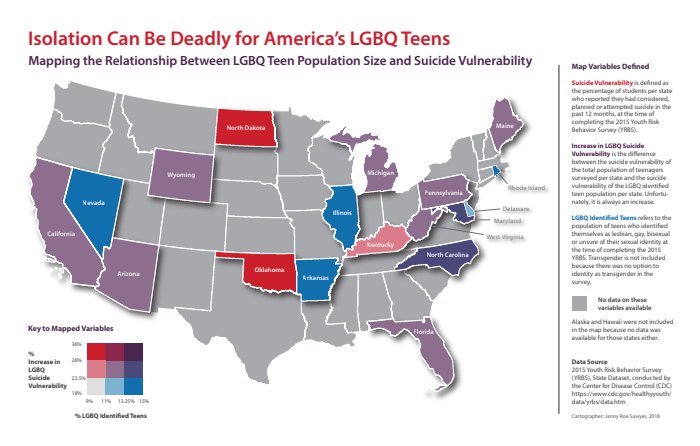

After hearing for many years that suicide rates among teenagers who identify as LGBTQ (Lesbian, Gay, Bisexual, Transgender, Queer or Questioning) are much higher than the suicide rates of the overall teen population, last spring I decided to investigate this issue for myself. I used data from the Center for Disease Control’s Youth Risk Behavior Survey (YRBS) 2015 state level dataset to analyze and map the spatial relationship between the size of the LGBQ teen population per state and the suicide vulnerability of the LGBQ teen population per state. The results of my analysis were striking and disturbing, though unfortunately not surprising.
The CDC’s YRBS is a survey administered at the national, state and district level, that asks participating high school students questions about “risk related” behaviors. These questions regard nutrition, drug and alcohol use, sugar intake, depression, suicidal thoughts, exercise and fitness levels, sexual behaviors, wearing a seatbelt, wearing a bike helmet, etc. For the first time, in 2015, the YRBS asked two questions regarding sexual identity. These new questions allowed me to use the state level data to calculate and analyze the percentage of teenagers in each state who identified as a sexual minority, the percentage of teenagers in each state who had considered suicide, the percentage of sexual minority students who had considered suicide, and the difference between those rates by state. At the state level participation is voluntary and only eighteen states chose to participate fully enough for me to include them in my study. Across these eighteen states, I wanted to answer the following questions.
Research Questions:
• How much higher is the suicide vulnerability among the LGBQ teen population compared with the overall teen population?
• Does this difference vary geographically from state to state?
• What is the relationship between the size of an LGBQ teen population and the suicide vulnerability of that population? Can this relationship be mapped?
• Is there any relationship between the suicide vulnerability in the overall teen population in a state and the suicide vulnerability of the LGBQ population in that state?
Creating Variables:
To create an LGBQ variable and a Suicide Vulnerability variable for my analysis, I used the following questions (and possible answers) from the 2015 YRBS:
• Q68: Which of the following best describes you? (1 = Heterosexual, 2 = Gay or Lesbian, 3 = Bisexual, 4 = Unsure)
I used this question to create the LGBQ variable. To do so, I recoded all the heterosexual responses as zero and all of the sexual minority identities as one. This recoding allowed me to differentiate the LGBQ students from the rest of the student population. (It is important to note that in 2015 the YRBS survey did not offer an option for students to choose “transgender” as a sexual or gender identity, so the transgender identity is necessarily excluded from this study.)
• Q27: During the past 12 months, did you ever seriously consider attempting suicide? (1 = Yes, 2 = No)
• Q28: During the past 12 months, did you make a plan about how you would attempt suicide? (1 = Yes, 2 = No)
• Q29: During the past 12 months, how many times did you actually attempt suicide? (1 = 0 times, 2 = 1 time, 3 = 2 or 3 times, 4 = 4 or 5 times, 6 = 6 or more times)
I used these three questions to create a Suicide Vulnerability variable for this study. This variable identifies a respondent as being vulnerable to suicide if that person has seriously considered, planned or attempted suicide in the past 12 months. In order to create this variable, I recoded the responses for Q27 & Q28 as 0 = No and 1 = Yes. For Q29, I recoded 0 = zero suicide attempts and 1 = any number of suicide attempts. This recoding allowed me to differentiate the students who had considered, planned and/or attempted suicide in the past 12 months from the rest of the student population. In all these questions, I recoded the most common answer or majority as zero, and the less common answer or minority as one. I chose this binary to make my statistical calculations easier in the DPLYR package in R.
Next, I loaded my pared down data set with the new recoded variables into R and used the data manipulation verbs filter(), select(), group_by(), summarize() and mutate() to create my own state level statistical variables from the data. Using DLPYR, I calculated the following four variables for each state.
• Total Teen Suicide Vulnerability: percentage of teens who considered, planned or attempted suicide in the past 12 months
• LGBQ Suicide Vulnerability: percentage of LGBQ teens who considered, planned or attempted suicide in the past 12 months
• LGBQ Identified Teens: percentage of teens who identify as LGBQ
• Difference in Suicide Vulnerability: percentage point increase in the suicide vulnerability of the LGBQ population compared to the suicide vulnerability of the overall teen population
Results:
Using bivariate regression analysis in JMP and interactive data visualization in GeoDa, I found two striking statistically significant relationships. In confirmation of my own hypotheses, I found a very significant relationship between the size of the LGBQ teen population and the suicide vulnerability reported within that population, and I found an even stronger statistical relationship between the size of the LGBQ population and the difference in suicide vulnerability reported by that population verses the overall teen population. As the percentage of LGBQ Identified Teens decreases, the suicide vulnerability reported by that population increases, as does the percentage point difference between the LGBQ suicide vulnerability rates and the suicide vulnerability rate of the total teen population.
The strongest predictive relationship exists between the size of the LGBQ population and the difference in the suicide vulnerability of the LGBQ population compared the the overall population. The negative relationship is statistically significant beyond 99% certainty. This model predicts that for every 1% increase in the percentage of LGBQ Identified teens the difference in suicide vulnerability between the LGBQ population and the overall population decreases by almost two whole percentage points (and vise versa). Additionally, just one variable, percentage of LGBQ Identified teens, explains 67% of the variance in the Difference in Suicide Vulnerability (between LGBQ teens and teens overall) across the participating states, which is rather astounding.
Accordingly, the range of Difference in Suicide Vulnerability between the LGBQ population and the total teen population in each state is quite disturbing. Even in states where the difference is the lowest, there is still an 18-point increase in the percentage of LGBQ teens who have seriously considered, planned, or attempted suicide in the past 12 months, compared to the overall teen population. The mean difference is a 24% increase, and in the most dangerous state to be an LGBQ teen in this study (Oklahoma), the difference is 35.5%. Therefore, even in the state with the lowest difference, LGBQ teens are still almost 20% more likely to consider, plan or attempt suicide than the overall teen population. Keep in mind that this is just the percentage increase in suicide vulnerability for LGBQ teens. The total suicide vulnerability of the LGBQ teen populations across all 18 states in the study ranges from 35% to 50%. This means that 35-50% of LGBQ teens have considered, planned or attempted suicide in the past 12 months, compared to only 14-21% of all teens who have considered, planned or attempted suicide in the same time period. The increase in suicide vulnerability among LGBQ teens is striking in every state in our study, even in states where the difference is the lowest. The mean suicide vulnerability among the total teen population per state shown here is 16.7%, compared to 40.6% among LGBQ youth.
Conclusions:
Clearly, the data in this study shows that the high levels of suicide vulnerability present among LGBQ teens in the United States is a massive public health problem. Across the US, 40% of LGBQ teens on average reported having seriously considered, planned or attempted suicide in the past twelve months. This is awful, appalling, dangerous and unnecessary. As a society, we need to collect and analyze more data, perform more research, and organize more public health outreach and policy initiatives to address this extremely important issue.
Originally, I had also surmised that the rate of suicide vulnerability in the overall teen population per state might have an effect on the LGBQ suicide vulnerability rate per state as well; I was surprised to find that relationship to be statistically insignificant. At first, this seemed odd but unimportant. However, the more I sat with the data, the more it seems obvious that this “non-relationship” truly points to how massive of an effect identifying as a sexual minority has on a teen’s life. Identifying as LGBQ brings along an unbelievable number of emotional, social, political, personal, and religious complications. Therefore, it seems that just this identification alone has such a huge impact on the suicide vulnerability of LGBQ teens, that the other issues universally affecting teens around them in their state (such as economic or regional factors) bear little impact in comparison to identifying as a sexual minority. It cannot be possible that the regional factors causing high overall teen suicide vulnerability in certain states do not affect LGBQ teens; they must be affected equally because they live there just like everyone else. Therefore, the only logical conclusion is just that the effects of these regional factors are very small in comparison to the effects of the LGBQ identity. Thus, even in today’s increasingly accepting and open society, it is clear that we have a long way to go in combating the stigma, fear, anxiety, depression, prejudice, rejection, judgement, secrecy, confusion, mistrust, and self-loathing that can come along with a identifying as an LGBQ teen.
In conclusion, even though social acceptance of the LGBTQ community has grown drastically in the past few decades, we fall into the trap of pretending that LGBTQ teenagers or adults are just like everyone else. There are still many reasons why it is very difficult to be out as an LGBTQ person even today. Thus, LGBTQ teenagers (and most likely LGBT adults as well) are at a much higher risk of attempting to commit suicide than the rest of their peers. This makes them different, and we must not ignore this difference. Their lives may depend on it.
NOTE: This is a shortened summary version of a full report on this study.